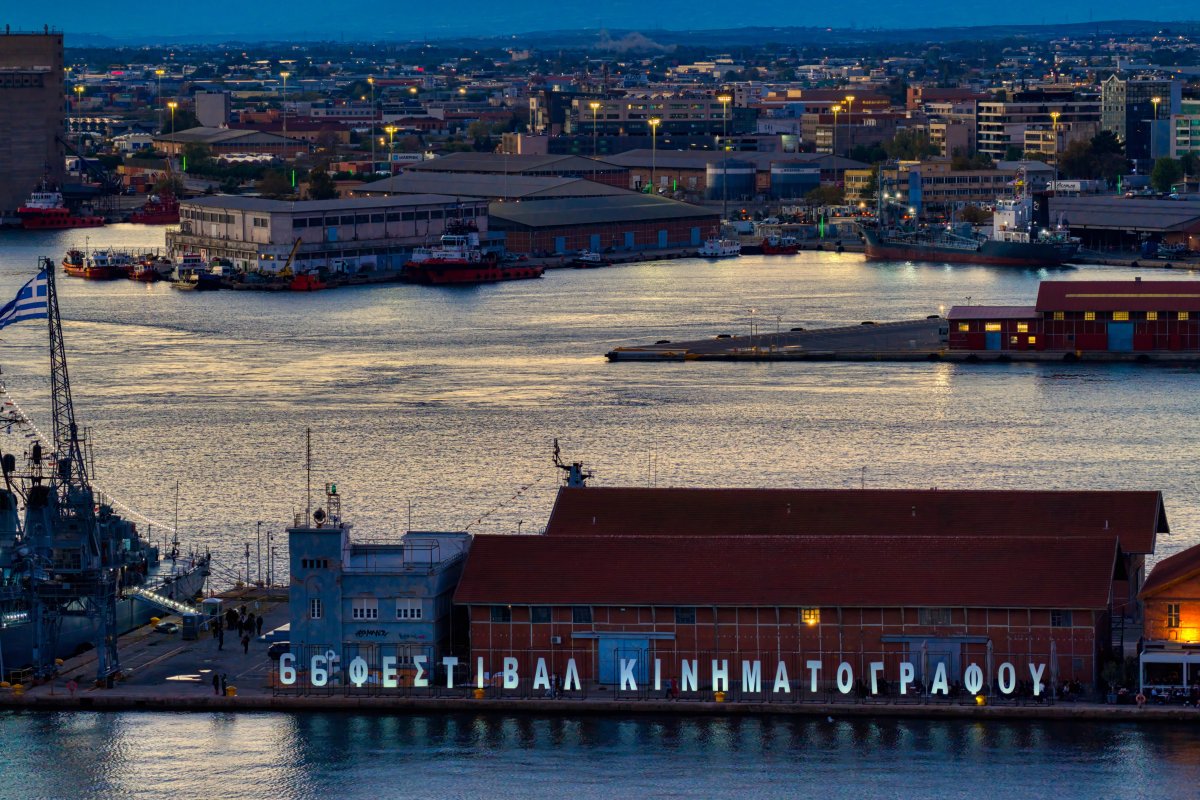

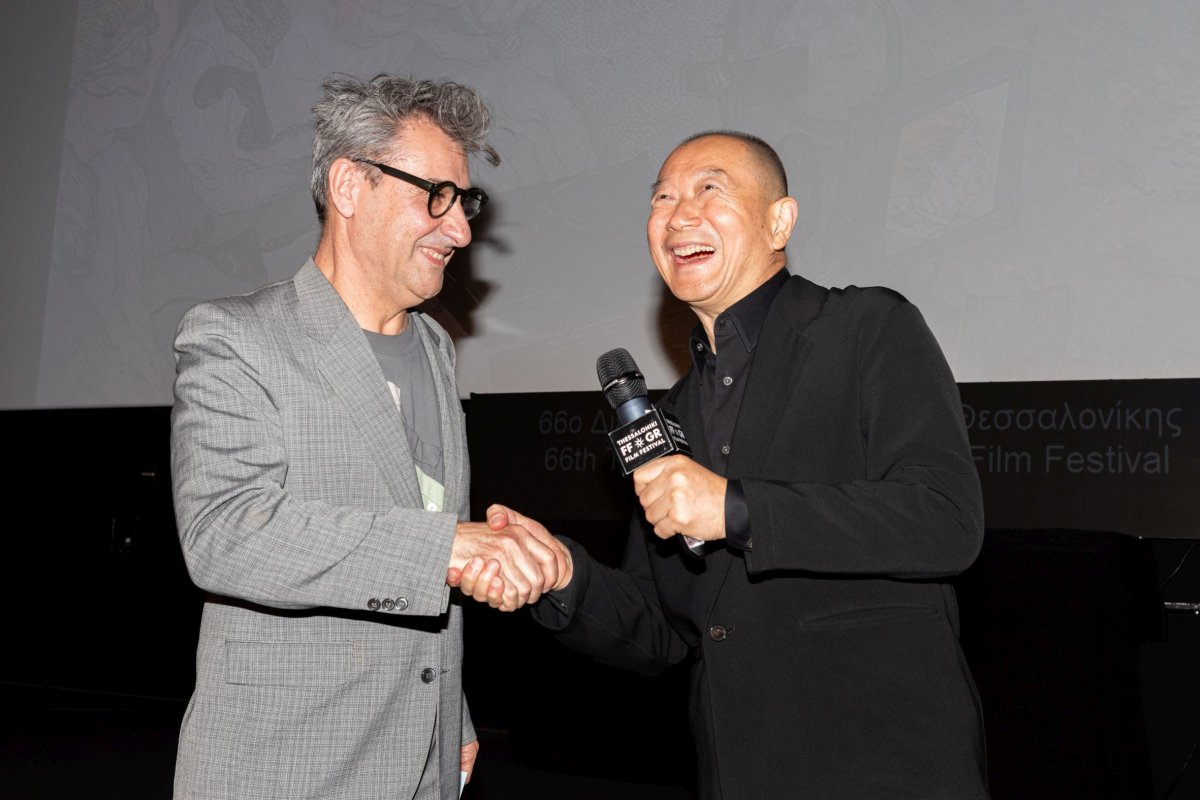
The beloved screening series Fundamentals of Cinema, devoted this year to modern masterpieces destined to become future classics kicked off on Wednesday, November 5th at the John Cassavetes theatre as part of the 66th TIFF, with the screening of the film Crouching Tiger, Hidden Dragon (2000) by Ang Lee. The screening was prefaced by Chinese-American composer and maestro Tan Dun, one of the most acclaimed and radiant names of contemporary classical music, Academy Award and Grammys winner for the film's music. This year's edition of Fundamentals of Cinema brings to the fore contemporary films shot in the late 20th century and early 21st century, which are expected to become modern classics and serve as a reference point for both cinephiles and film theorists-scholars alike.
Orestis Andreadakis, the Festival’s Artistic Director, prefaced the screening, welcomed the audience and expressed his joy at the presence of the great composer at the 66th TIFF. At the same time, he announced that the screening of the film Crouching Tiger, Hidden Dragon marks the beginning of a beloved section of screenings of TIFF’s annual activities: “This screening is very important to us for two reasons. Firstly, we are hosting one of the most important film music composers whose name is associated with great films such as Crouching Tiger, Hidden Dragon, which we will shortly watch. Secondly, because this screening marks the launch of this year's beloved section of the Festival's annual program, Fundamentals of Cinema, which carries the subtitle New Classics. The list includes nine films shot about 25 years ago, in the era when today's students, who make up the main audience for this section, were born. We wanted to rewatch them and allow people to discover some new classic masterpieces for the first time. Specifically, the films that will be screened are: Magnolia (1999), The Blair Witch Project (1999), A.I. Artificial Intelligence (2001), American Psycho (2000), Being John Malkovich (1999), Oldboy (2003), Fight Club (1999), Talk to Her (2002) and Crouching Tiger, Hidden Dragon (2000) by Ang Lee. It is a great honor for us that a great musical artist will have the grand opening,” Orestis Andreadakis said, before giving the floor to Tan Dun.
“I love Greece and I love cinema!” Tan Dun, the composer, added with enthusiasm. “The most important thing in cinema is the plot of the film, as well as the music. The plot shapes the narrative present, it is the reason you watch a film. You can definitely feel the importance as you have spent money and time, and time is more important than any amount of money. But after the screening, what is lasting? How can we preserve something that touched us in perpetuity, maintain this experience of artistic and spiritual depth, in order to remember the film? I believe that this is the role that music comes to fulfill, and that is why it’s so essential”, he initially stated.
“The problem is that in the final stages of a film production, the producer and the director always claim that music is very important to them, but they never spend enough money on film music. So the important thing I learned from all these great composers, from Ennio Morricone to John Williams and Hans Zimmer, is that if a film offers you a chance, it is your duty to repay that by doing your very best, even if the circumstances are far from ideal. For these reasons I would like to thank the director of the film, Ang Lee. At the time the film was made, we were all poor artists living in New York city. He kept telling me about the beautiful landscapes, the choreography and the spirit of the martial arts in the film. At the end of his stories, he would always add: “the music will be the soul of the film”. I would ask him jokingly “what will the budget for the music be?” and he would always answer that, unfortunately, it would be zero. I decided to take that challenge. It was the biggest challenge in my musical career, but I was determined to succeed. In the endless hours of hard work that followed, we could have never imagined that 25 years later we would still be meeting people who remember this film with such affection. For this reason, I want to thank TIFF, Artistic Director Orestis Andreadakis, and all of you in the audience who are here to share the experience of watching this film. And I believe that, as I mentioned before, the music is what will keep the memory of the film alive in the future,” the composer stated.
At this point, the famous maestro referred to the concert he will give on Thursday, November 6th at the Thessaloniki Concert Hall, offering the Festival the opportunity to expand its already successful collaboration with the Thessaloniki State Symphony Orchestra: “When I met Orestis Andreadakis yesterday, I expressed my interest in starting a collaboration between Greece and China, a dialogue that will mirror and compose a reflection of the spirit and culture of these two countries. In my career, I have composed music for over 25 Chinese films. Tomorrow I will have the pleasure of presenting the music of three of them, one of which is the film Crouching Tiger, Hidden Dragon (2000) that we will shortly watch, along with Hero (2002) and The Banquet (2006). Using music as a tool, I tried to compose a story, using elements from all of these three films. If you have time, I would be very happy to see you there,” Tan Dun noted.
“When we hear everything you say, I think we fully understand Nietzsche’s saying: without music life would be a mistake”, Orestis Andreadakis concluded.